With the World Cup just around the corner, Spanish football is once again the talk of the football world. As national teams finalize their preparations for the biggest international tournament, Spain has once again found itself at the center of the football landscape thanks to its strong presence in recent European finals.
Over the past few weeks, Spanish coaches have taken center stage in Europe’s major competitions. No fewer than six of the eight managers involved in the continent’s biggest finals were Spanish:
In the UEFA Champions League final, Luis Enrique (Paris Saint-Germain), for the second consecutive year, and Mikel Arteta (Arsenal) battled for the title at the end of May. Just one week earlier, Pere Romeu (FC Barcelona Women) defeated Jonathan Giráldez’s Olympique Lyonnais in the UEFA Women’s Champions League final. In the Europa League final, Basque manager Unai Emery secured his fifth title in the competition, this season leading the English side Aston Villa. Finally, coach Iñigo Pérez guided Rayo Vallecano to its first-ever European final, although they were unable to claim the UEFA Conference League trophy.
Far from being a coincidence, this phenomenon reflects a model that has spent decades developing top professionals and serves as yet another example of the enormous influence Spanish football continues to exert at the highest level of the game.
Spanish coaches leading the way in Europe
The presence of Spanish coaches and clubs in the finals of the Champions League, Europa League, Conference League, and Women’s Champions League confirms a trend that has persisted for years: Europe’s biggest clubs continue to place their trust in Spanish managers to lead their projects.
The influence of Spanish football is no longer limited to its players. Coaches have become one of the country’s greatest football exports thanks to increasingly specialized training, strong tactical preparation, and an adaptability that allows them to succeed in a wide variety of environments.
LaLiga academies and their proven model of success
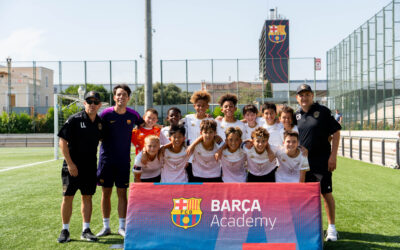
The success of Spanish coaches is only part of the story. For decades, Spain has been one of the world’s leading producers of football talent, and its academies are a clear reflection of that reality.
The youth academies of Spanish clubs continue to develop players capable of competing at the highest level, while LaLiga remains one of the most prestigious and attractive leagues in the world, including at youth level. The combination of player development, technical training, and tactical understanding has enabled countless Spanish footballers to excel in both domestic and international competitions. As a result, “La Roja,” powered by its new generation of stars, is once again attracting attention ahead of another World Cup.
In addition, LaLiga clubs have historically demonstrated a remarkable ability to compete in Europe. The continental titles won by Spanish teams over the past decades have helped reinforce a football culture built on competitive excellence and a commitment to developing talent.
The methodology behind spanish football’s success
Behind all of these achievements lies a methodology that is internationally recognized. Spanish football has built its identity around developing technically skilled players with a deep tactical understanding of the game and a strong ability to make decisions under pressure during matches.
What truly distinguishes Spanish football from other major leagues and footballing schools is its approach to the game. While other countries often prioritize physicality, speed, or intensity, Spanish player development focuses from an early age on technical mastery of the ball, tactical intelligence, and the ability to understand and manage a wide range of situations on the pitch. A player trained under the Spanish methodology learns to make constant decisions, understand space both on and off the ball, combine effectively with teammates, and maintain control of the game even under pressure.
This philosophy has produced a recognizable style based on possession, ball circulation, and collective play, where individual talent is placed at the service of the team. Furthermore, there is a close connection between grassroots and professional football, allowing young players to develop a common footballing identity throughout their training. This combination of technique, tactical knowledge, creativity, and team culture is one of the main reasons why Spanish football has managed to distinguish itself and become a model admired and replicated around the world.
This model has not only benefited players but has also produced coaches, fitness trainers, analysts, and other professionals who now work for some of the most important clubs and national teams in the world. The commitment to youth development, the professionalization of sporting infrastructure, and the emphasis placed on the holistic development of players have made Spanish football a benchmark for many countries across the globe.
For this reason, with the World Cup approaching, Spain once again finds itself among the national teams generating the greatest expectations. The success of its clubs and coaches reflects a strong structure that also feeds the national team.

Spain emerges as one of the favorites to win the World Cup
After winning the most recent UEFA European Championship and establishing a new generation of elite footballers, Spain approaches the 2026 World Cup with ambition and confidence.
Players such as Lamine Yamal, Pedri, and Rodri—the standout stars of FC Barcelona and the recent Ballon d’Or winner, respectively—represent both the present and the future of a team that has regained its belief in competing for the game’s biggest trophies. Alongside this individual quality is a recognizable playing identity and a collective structure that has allowed Spain to remain among the most competitive national teams on the international stage.
After several World Cups marked by performances that fell short of expectations, Spain appears to have found the right balance between youth, talent, and experience. As a result, many predictions place Spain among the leading contenders to challenge for the World Cup title.
The objective is clear: to win again the trophy they famously lifted in 2010 and confirm that the outstanding moment currently enjoyed by Spanish football can also be translated into success at international level.
Regardless of what happens at the 2026 World Cup, Spanish football and its methodology will continue to shape the future of the modern game. From elite academies such as Real Madrid, RCD Espanyol, Athletic Club Bilbao, and FC Barcelona, among many others, to the coaching staffs and executive boards of Europe’s and the world’s biggest clubs, Spanish football continues to leave its mark. It is a journey that reinforces a methodology internationally recognized for its ability to develop talent year after year, produce outstanding professionals, and understand football through a comprehensive and holistic perspective.